Blomberg.net reports that Vivi, the missing whippet has been seen again. Apparently the Westminster Dog Show champion was glimpsed several times in New York's Flushing neighborhood during the past week.The latest sighting was... at 3:45 a.m. Tuesday, New York time, when a man spotted Vivi in Flushing Cemetery. He took his Doberman into the cemetery and the two dogs touched noses, according to a search volunteer.
The whippet's owners have posted a $5,000 reward for her, and the search has drawn more than a hundred volunteers to the New York suburb, located about 10 miles north of JFK Airport.
Volunteers plan a stakeout on March 25, when they will assign teams to different areas to stay put and watch for the whippet to make an appearance. In the meantime, traps have been set in the cemetary, and the owners are hopeful that they will soon have their dog back.
Vivi is a purebred whippet, which resembles a miniature greyhound. She is mostly white with dark brown stripes called brindle. She has brown ears and a dark head, with what looks like a white stripe down her face. Whippets are fast, and can hit speeds of up to 25 mph within seconds from a virtual standstill.
[dog news]
[dogs]


Different Types of Aggression in Dogs
Aggression is one of the main reason dogs are euthanised or rehomed. At least 30% of all dogs in rescue centres are there because of the incidence of aggression in one form or another. It is actually unusual to have a dog that is aggressing to have just one type, Most dogs have more than one of the following types of behaviour...
 It would be prudent before embarking on any program of aggressive behaviour modification, to rule out any medical reasons for that behaviour, especially if there is a sudden change in the dog’s temperament. Their are some fifty-odd different medical reasons why a dog may be showing aggressive tendencies, these range from Pain to Thyroid Dysfunction, Epilepsy Hypoglycaemia and Diabetes. This is only a part of the different types of aggression, because of the constraints of space it can only be a fleeting reference. I have covered fully “Food Guarding “and “Object and Possession Aggression”in previous articles in Dogs Monthly (one of the numerous magazines I write articles for)
1. Fear / Nervous Aggression (Interdog)
Quite often, this behaviour has its roots directly to the pup’s mother. Breeders that breed from fearful and timid bitches will often make excuses as to why you cannot see the dam. If you do view a litter of puppies and the mother is fearful then do not even consider buying a puppy. It is almost certain that the pups will inherit some of the mother’s traits, through both genetics and socialisation, genetically the pups may inherit her timidity and through the time they are with her will observe her fear and follow suit.
Scientific research has shown that even pups that are born to a solid and stable mother are then put with a bitch that is fearful, they will pick up some of the unstable habits from the fearful dog, especially in weeks three through to seven. Other reasons for this fear type of problem is when a puppy or adult dog is attacked by another dog, especially whilst on the lead, especially if the dog has no means of escape or is restricted from showing submissive body language to the attacker. If we then comfort the injured or frightened dog we only confirm that the fear is real and that wil only make matters worse.
Lack of early socialisation can also have an affect on this type of behaviour, If the young pup, especially between the age of seven and sixteen weeks, is not carefully socialised with both adult and pups alike, then they do not learn to “meet and greet” . The complex body language dogs learn at this age is crucial to their later behaviour when approaching unknown dogs. If they are unable to either perform or understand the greeting rituals, then they are immediately viewed with suspicion by the approaching dog, and conflict may arise
How can you tell if it is fear?
With nervous and fear aggressive dogs, you will find that they will react similarly to any dog, regardless of whether it is male or female. The behaviour is often worse if the dog is on the lead or is cornered, especially if close to the owner, who backs up the behaviour, (though unwittingly) by becoming nervous and agitated as another dog approaches.
This manifests itself in a tightening up on the lead and shoulders because of the expectation of conflict. Nervous owners also kick out a cloud of adrenaline that the dog instantly detects a causes it to look for what is causing the concern. It sees the dog approaching and reacts accordingly. This type of dog is also normally a barker, it will lunge and bark at the approaching dog but generally will not snap, unless all its options have run out ie flight or freeze and after all its threat posturing the other dog has still got too close.
This problem can often be diagnosed if someone who is confident around dogs (that the dog does not know well) takes it out on the lead. It will not get the same fearful vibes from the owner, therefore the reaction to another dogs approaching will be less intense. It is a good way of finding out if your dog suffers fear aggression as the behaviour will either not be exhibited or will be less pronounced. The owner can then use a desensitisation program for both the dog and themselves.
2. Fear / Nervous Aggression (Inter-human)
Once again, this can be caused through lack of early socialisation, bad breeding and sometimes lack of handling at an early age, starting as young as two weeks old. Pups that are not handled gently and often by the breeder, do not get the strong olfactory and tactile bond with humans. This is often the case with puppy farmed dogs and dogs born to large breeders. This handling at such an early age causes a mild stress response in the tiny pup, which benefits its ability to cope with many situations including people and dogs in later life
Nervous and fear aggressing is always defensive in nature, sometimes it is related to the sex of the person. If the breeder was female, and very few males visited or handled the puppies then the timidity and fear may be worse with men. This particular problem like interdog hostility, will manifest itself mainly with individuals rather than crowds. You will find that the puppy/dog will bark a lot but will be under a table or behind a settee. The tail will be down and although it may seem overtly aggressive, the dogs balance and weight will be on the back foot not over the front feet. This demonstrates that the dog wants you to go away and is not always initially trying to bite or attack you. A gradual and careful introduction to the stimulus that is causing the fear with positive reinforcement for calm behaviour is the way to overcome this type of problem though the dog will rarely make a total and full recovery and will be life and soul of the park parties.
3. Frustration Aggression
Research has shown that dogs who are not allowed to interact “normally” with people and dogs who were prone to displays of bad temper and behaviour that was overtly aggressive are dogs that are generally physically restrained or restricted from normal interactions (interactions with people, other dogs, and the outside world). The more the dog develops an intense desire to gain access to all of those things he desires.
This desire can escalate into escape and roaming behaviour, agitation, biting and unprovoked attacks. It is often observed in dogs that are left tied up in flats, left in gardens, or near a window where they can see the things they want to interact with, but cannot get to them display unprovoked aggression. To some extent the aggression shown to the postman is sometimes based on frustration. I have seen dogs attack their owner or a second dog in the home because it cannot get to the delivery man.
4. Sexual aggression.
This type of aggression is usually limited to male dogs. They will mount both people and other dogs. Mounting activity directed towards humans may reflect a lack of opportunity for the dog to play with other dogs, or an over-attachment to people in early life, Mounting on other dogs especially if they initially try to put their heads over the other dogs necks can be related to rank and control complex behaviour. Castration and behaviour modification can help with this problem. Allowing the dog to mate may often be recommended by the amateur dog expert, this normally makes the problem far worse.
5 Territorial Aggression
This may be towards other dogs, people or both. By definition, territorial aggression should be directed toward members of the same species ie other dogs. Domestic dogs, however, seem to regard humans as conspecific and consequently may direct territorial aggression toward us When dogs display aggression to strangers only on the home property garden, house, or yard, yet do not respond aggressively to strangers on neutral territory, then territorial aggression is the likely diagnosis. There are two primary motivations for territorial behaviour, control complex behaviour ie dominance or fear/anxiety. It may be worse in a small space such as a car than in an open area . Some dogs like this can be fine in the home, but not so good in the garden or yard.
Some breeds appear to frustrate much quicker than others, these are generally the working dogs such as Collies, Springer’s Cockers and some Retrievers The only answer to this problem is to work on the dominant/territorial problem in a way in which a dog understands its position through a behaviour modification programme using position reinforcement techniques. Remember not to praise for the cessation of bad behaviour rather praise for that bad behaviour not happening in the first place. In other words, say the dog jumps up on someone and you say “OFF” if the dogs get off then do not praise as you will be praising for the inappropriate behaviour, which was the jumping.
6. Control Complex / Dominant Aggression
The initial approach to other dogs is often cautionary and contains many status signals, like tail carriage held high and quickly moving from side to side, standing on tip toe etc. If the other dog submits, then all is usually fine, if not the fighting can be extremely noisy and in some cases quite severe. In both the last two examples, dominant and territorial aggression, I usually find the dog will pull quite badly on the lead. These dogs can also display aggressive tendency towards members of the family this could lead to an attack if not controlled in their early stages. By working on a programme that will give the dog a purpose and a position in life almost a job and teaching the dog to walk on a loose leash can sometimes overcome the problem. The type of program I would use is the NILIF program which stands for “Nothing in Life is Free” See my website under dominance
7. Chase or Predatory aggression
This can be directed at many things including dogs, cats, or anything that stimulates a chase response. Squirrels are a favourite, as their quick jerky movements seem to stimulate even the most placid of dogs. I see a lot of predatory chase aggression in for instance Border Collies, in particular stimulants like bikes, skateboards joggers and cars.
One of the key factors that distinguish predatory aggression from other forms of aggression is that movement often is the triggers . In the wild, this movement is in the form of running and escape attempts of a small animals. Predatory behaviour can be seen in dogs of any sex and age. Dogs that show intense interest and become aroused or anxious by the movement or noise of children or other pets should be closely monitored at all times. Prognosis is not good for this type of aggression. Reward based obedience training can help however this is only any use if the owner/trainer is able to constantly monitor the dog at all times.
It is easier to control the chase stimulus when it is directed at cars, joggers, or bikes. Two types of common treatment’s include counter-conditioning used to change the dogs’ perception of the falsely identified prey. Many also believe punishment works ie noise aversion when the behaviour is first stimulated. Throwing water from a car window or sounding a rape alarm or air horn at the exact time the dog takes off, throwing down a plastic bottle of stones from a passing bike or car can sometimes alter this behaviour.
However. To be effective, punishment must be seen as aversive and the timing of the punishment must be exact so that the dog associates the punishment with the behaviour. Electric shock collars have also been suggested but are not part of treatment programs I would ever recommend.
As mentioned aggression often has its origins in bad breeding, lack of socialisation, high prey drive, and poor basic training. However, as stated before it can be related to medical conditions and before embarking on a course of behavioural therapy have your dog checked over to see if there are any underlying medical conditions.
Learned aggression can normally be cured however, hereditary aggression cannot, it can only be controlled and hopefully contained. Castration sometimes helps, and should be considered in an overall aggression reduction program.
This article was written by Stan Rawlinson, a full time Dog Behaviourist. You can visit his website at www.doglistener.co.uk for more articles and training information.
[dog training]
[dogs]
I just don't agree...

I mentioned in an earlier post that Miss Peaches and I were starting obedience classes. Well, we're in week 2 now, and I'm not at all sure that we're in the right place...
This training program was specifically recommended to me, by a local rescue organization, as one that specialized in pit bulls and "aggressive" breeds. Miss Peaches is still very fearful of new people and situations, and when she is scared, she does a "dart in and nip em" move that is very disconcerting (as you can imagine) to the folks she does it to.
I should point out here that her behavior with me is impeccable. She has never, not once, behaved in any way aggressively towards me. There are friends of mine with whom we go for walks, and she's never looked twice at them. On walks, she's very dog friendly, and if people ignore her and let her do her own introductions, she's fine.
She is, however, exquisitely sensitive to tension, stress, and fear "vibes". I assume that is a leftover survival mechanism she developed early on, and I'm sure it served her well then. If she could pick up the vibe early, she could take appropriate action and avoid getting hurt. The problem is that it's not working for her now.
I've been working on building her confidence in strange situations and with meeting a variety of people, using her muzzle and a lot of positive reinforcement. There are definitely measurable changes in her behavior. She's not as skittish when someone reaches out to her. She's even given a few choice people head rubs or rolled over for some bully-belly-lovin. And as long as everybody is relaxed, everything is fine.
Part of the reason I wanted to go to a class was for socializing purposes, and partly to have the - trained - eye of a trainer on us both to help me make sure I'm doing it right. I've "home-schooled" my other dogs successfully, but I have no experience with this kind of problem.
When we arrived for our first class, driving 20 minutes through a hellacious winter storm to get there, I and the other two people who had battled our way there were told by our instructor (let's call her "D") that she was canceling the class for that night. This was so the other four presumptive attendees (who had not shown up or called) would not miss anything. *Aside - This is my problem, exactly how???*
None of us were pleased. Still, we all returned the following week.
That week, we were all told that we should be wearing prong collars, instead of the regular training collar. Prong collars were handed out, and D showed us how to clasp and unclasp them. No mention was made on how to fit them correctly, nor did she point out the difference between the "dead" and "live" links.
(For those of you who were as ignorant about this as I was , there are two possible connecting rings to hook the leash into. The "live" link gives a much stronger correction than the "dead" link. Also, the collar should fit snugly up behind the ears, not down on the neck like a regular collar. Many trainers recommend that the prongs of the collar be centered on the side of the neck away from you, and not directly across the soft underside of the dog's throat. All of this is information I discovered after the fact, on my own.)
This last lesson, the class was working on "heel". In the class is a Retriever puppy who, like so many Retriever puppies, is goofy, exuberant and apparently afflicted with a significant case of ADD. He was having some trouble staying focused, and the frustrated owner was being instructed to give some pretty severe corrections. The puppy began getting very stressed out, and was definitely not having any fun. As he and his owner passed between us and the wall, she gave him another very strong correction, with a very loud "No!"
At this Peaches, who had been getting more and more tense as this exercise progressed made a lunge at this woman, and for the first time ever, growled at her.
She has never acted like this before, since she has been with me. Never.
Peaches was wearing her muzzle (on the Better Safe Than Sorry Principle) and so no harm done. In fact, the owner didn't even really seem to notice the incident.
But honestly, Peaches acts worse in this class than she does at any other time during the week. Granted, it's a stressful situation for her, and that was partly the point, but still...And then, to add the finishing touch, D is now pushing me to use an e-collar (or electronic shock collar) on her.
Which I totally disagree with.
I am not completely against the use of such a collar. I think they can be very effective for some nuisance behaviors such as barking or chasing cars.
But I simply do not see how using one on a fear-aggressive dog is going to be helpful. The purpose of the e-collar is for the dog to associate the unpleasant shock with the behavior. Since in this case the behavior is triggered by stress and fear, it seems to me that there is a pretty good chance that she will associate the shock with the feared thing that triggered it. Which will be a person or another dog. And I just don't see how that can be a good thing.
My gut instinct tells me that an e-collar is the entirely incorrect approach to take with this dog. I believe there is a real chance of ruining her permanently if using this method backfired. And I'm not prepared to take that chance.
I'm going to do more research on this, and I'll post whatever I find. In the meantime, Peaches and I will give this class another chance, but we'll just keep up with our own program of getting out of the house more.
It'll be good for us both.
[dog training]
They shoulda let this sleeping dog lie...
6:00 am Sunday morning at la maison des animaux...
Poodle-Thing Pepito hurtles from the bed to the back door barking as though all the fiends of hell were trying to break in. Joined almost instantly by a full throated chorus from his homies, previously deep in slumber and gently snoring. In the ensuing clamor, cats fly in all directions seeking the high ground. Food bowls flip, kibble scatters generously across the freshly-swept-last-night kitchen floor.
I spring from my bed, instantly jolted from early morning REM by my now-pounding heart. Running to the back door, I flip on the outside light to see... a small raccoon. Probably weighing about 7 pounds, and judging from the tracks in the snow, all alone. And probably trying to sneak in for a couple of handfuls of kibble.
Lord knows I wouldn't have wanted to sleep through that.
After some coaxing, the dogs are convinced that I can handle this imminent danger to life, limb, and the pursuit of happiness, and we all go back to bed.
But not to sleep. Oh, no. That would be too simple. And too kind, even.
15 minutes later, Nola, who is thrashing herself around in her Rat Terrier ritual that precedes sleep, manages to flip herself off the bed and on to the wood floor, where she lands with the resounding thud of a dog 10 times her actual weight.
Heart-rending screams split the quiet. All other dogs return to full alert and full volume. Cats scatter once more. Heart pounds. Sleep retreats swiftly.
Examine Nola for broken bones (none) and injuries (none) and return her to bed. Other dogs return to bed. I return to bed. Much grunting, sighing and turning around. Finally, silence settles.
7:00 am. Peaches moans piteously from her crate, a sound which generally means that she has a tummy issue and has to go outside RIGHT NOW. I stumble out of bed, and pull on a jacket. At the sight of me apparently getting dressed, the canine chorus erupts once more and my ankles are submerged in the tidal wave of dogs. All of whom are now insisting that, yes, they too, have to go outside RIGHT THIS VERY MINUTE!!!
I open the door to a swirling snowstorm. Everyone, and I mean everyone, recoils at the sight of the blizzard outside, and makes a U-turn for bed. Deciding that - you know what - they don't have to go quite as urgently as they thought they did five seconds ago.
No such luck. I pitch the lot of them outside, where they cringe and hunch their backs against the driving snow as they pee, all the while shooting me furtive looks of abandonment and abuse. You know the kind I mean. The squinty looks that suggests that you are the worst dog person on the planet, and that they are the unluckiest dogs ever born.
But my heart has been hardened by repeated false alarms. Pee they must, and pee they do. And are now happy to return to their respective warm beds.
Where we sleep undisturbed until a lazy 10:00 am this morning. Without another peep. From anyone.
Sometimes I can be a bitch too.
[dogs]
Dogs, dogs, dogs - 24,000 of 'em!

This bowler-hatted gent and 24,000 others like him from 32 countries are flocking to compete in the 2006 Crufts Dog Show, held in Birmingham, England. The cream of almost 200 breeds will be competing to succeed Coco, a Norfolk Terrier who was last year's winner of Best in Show.
Cruft's is sponsored and run by The UK Kennel Club, and they hold competitions for the both the purebred and the pooch. Like the Scruffts Competition specifically for the...crossbred companion.
And this year's competition features a Lady and the Tramp Look-a-like Competition, with a short list of 10 finalists. The dogs the will be judged on how closely they look and act like Tramp, Lady, Trusty or Jock, and will be asked to perform one of the following tasks:
Lady will be asked to fetch a newspaper for her owner.
Tramp will be asked to catch a toy that is thrown.
Jock will charm the judges by looking like a bonny wee lad in his tartan coat.
Trusty will prove he hasn’t lost his sense of smell by sniffing out a hidden treat.
The winner receives a year’s supply of Iams dog food. No word on whether the audience gets to vote, "American-Idol" style, for the winner.
The show is now in its 115th year, and attracts tens of thousands of visitors for its four days of competition. It is officially recognised as the world's largest dog show by the Guinness Book of Records, and has almost 400 trade stands offering visitors the latest dog-related products.
[dogs]
[dog news]
Oscar Goes to the Dog!

One of my favorite dogs (who cares that he's animated!) took home a Golden Boy last night. And I'm not talking about George Clooney...
The Oscar for Best Animated Feature Film went to Wallace & Gromit in The Curse of the Were-Rabbit. Using their own little fashion touch...co-directors Nick Park and Steve Box, the main clay manipulators behind Wallace & Gromit, placed gaudy striped bow ties that matched their own on their twin Oscars.
If you have somehow missed this marvelous little film, it follows the continuing adventures of Wallace, the cheese-loving inventor, and his literate, faithful sidekick dog, Gromit.
In their first full-length film, the duo's small English village suffers from a nightly scourge of ravenous rabbits. So Wallace designs the ultimate humane solution: an ultra-humane bunny-rabbit-sucker-upper known as the Bun-Vac 6000. (A spiral of bunnies swirling around in the transparent canister of the Bun-Vac 6000 is a vison to be treasured!)
Then, when the moon is full, there appears a monstrous rabbit with the strength of 10, teeth the size of ax blades and ears like terrible tombstones. Hapless hilarity ensues, with a nod to classic horror films, King Kong, and the obligatory car chase. There's even a romantic love triangle between eco-toff, Lady Tottington, milady's bloodthirsty suitor, Victor Quartermaine, and the genial and clueless Wallace.
Get the DVD, break out the popcorn, and curl up with your favorite sidekick pooch(s)for a couple of hours of a fun film!
Web site
[dogs]
The Muttly Crew - Dog Photos: Part 4

Pepito Mio, otherwise known as "Poodle-Thing" or "Little Dude". Was found in a yard with fighting pits, and was presumably scheduled to be used as a bait dog until Katrina intervened.
He was wearing a collar with tags, but when the shelter tracked down the owners, the owners said they didn't want him back. How anyone could not want this sweet Southern charmer is beyond me, because....Pepito is utterly adorable.
He loves to cuddle, and likes to sleep with some part of him touching some part of me. When he first arrived, I would wake in the morning to find him curled up around my head like a hat! He has since migrated further south, but still like to go to sleep snuggled in.
He adores Miss Peaches, and will curl up with her on one of the dog beds, preferably in the morning sun. He's something of a dreamy type, and when we're on walks he is easily distracted, and often finds himself left far behind the group. Poodle-Thing is no wuss, tho. He trucks along just fine on our long hill hikes, albeit at his own pace.
He has a healthy respect for the cats, and readily gives way to Angus or Clyde when he sees them coming. Probably because they both outweigh him.
Pepito was diagnosed as heartworm positive, and although we already went through one round of treatments, his most recent blood test showed positive again. This really sucks, because not only is the treatment very expensive where I live (it's rare, and the medication has to be special ordered, etc), he will have to be kept on extremely limited exercise for eight to ten weeks during the procedures. And he loves his walks!
My vet is looking into alternate protocols, since he's already been through the Immeticide treatments. The irony is that Pepito is completely asymptomatic - he shows no symptoms of the infection at all - and he's in great shape.
I guess we'll just handle this the same way we've handled everything else. We'll take it as it comes. However, if you want to send some luck, good wishes, and/or prayers our way, they sure would be greatly appreciated.
[dogs]
[dog health]
Yummy dog treats
My dogs love these easy homemade treats. Yes, I cook for my dogs, and okay, yes, my dogs are spoiled...
Bacon Flavored Dog Biscuit Treats
I N G R E D I E N T S
Yield: 40 dog biscuits
5 cups Whole wheat flour
1 cup Milk
2 Eggs
10 tablespoon Vegetable oil or bacon fat
1 pinch Onion or garlic powder
1 teaspoon Salt
1/2 cup Cold water
1 tablespoon Vegetable oil to grease pan
I N S T R U C T I O N S
Preheat your oven to 350 degrees.
Grease cookie sheets.
Mix all ingredients well. Pinch off pieces of the dough and roll them into two-inch balls. Bake biscuits at 350 degrees for 35 to 40 minutes. Let them cool, then store in an airtight container.
Originally from the Humane Society of Santa Clare Co., Santa Clara, CA.
[dogs]
[dog health]
Dogs, Spring, and...Parvovirus
For dog owners, Spring means more than warmer weather and longer walks. It's also a time to be sure that your dog is up to date on his vaccines, including a vaccine for parvovirus.
Once contracted, parvovirus can kill in 48 to 72 hours after the first symptoms of depression, loss of appetite, vomiting, and severe diarrhea appear. Puppies, especially those between weaning and six months of age, are at increased riskof acquiring the disease. There also appears to be a higher risk in certain breeds (e.g. Rottweillers and Dobermans).
Parvovirus or "Parvo" is a highly contagious viral disease that attacks the dog's intestinal tract, white blood cells, and in some cases the heart muscle. Since first appearing in the 1960's canine parvovirus (CPV) infection, has appeared worldwide.
Parvo infection can only be transmitted to dogs and other canids, like wolves, but not to other types of animals or people. However animals and people can carry it to your dog.
The virus lives in the fecal waste of infected dogs, and is incredibly hardy and resistant to environmental conditions, surviving for months. Large amounts of the virus may be present in fecal material of infected dogs.
The first signs will most often appear 5-7 days after the dog is exposed to the virus. At the onset of illness, the feces will generally be light gray or yellow-gray. Sometimes, the first sign will be fluid feces streaked with blood.
If you see symptoms of Parvo take your dog to the vet immediately! Very few dogs survive an untreated Parvo infection.
Check your dog's vaccination records to make sure that he has received his Parvo shots. Once innoculated, dogs should get a yearly booster, especially if you regularly take them to areas where large numbers of dogs congregate. And that's not just dog parks, either; Parvo has even been found in show dog arenas and kennels.
If you have a puppy, be sure to include her Parvo vaccine. Puppies under the age of four months that have not been inoculated are at greatest risk.
Puppies generally get a series of shots to prevent the disease. Many veterinarians finish the series at 12 to 14 weeks, and some vets suggest that puppies be innoculated up to at least 22 weeks.
If you are unsure whether Parvo is affecting dogs in your local area, check with your veterinarian; they will be able to give you tips on areas to avoid. You can reduce the risk of exposure to your dog by not letting him step in or make contact with, the feces of other dogs.
And of course, do your part to prevent the spread of this deadly virus - Always Pick Up After Your Dog!
[dog health]
[dogs]
[puppies]
Dog Psychics Called In
According to news reports, about 12 psychics have now joined the hunt for the missing show dog, which has now been missing for a week...
Although a tipster claimed to have seen the whippet around JFK Airport a few days ago, the dog hasn't been spotted since. However, droppings consistent with the 30-pound whippet's were found Monday behind an airport cargo building, and so there is still reason for hope.
The dog's owners have posted a reward of $5,000 for her return.
But each year, dozens of dogs and cats are lost and found on Kennedy's 5,000 acres, which stretch from the busy parkways in the north to Jamaica Bay's marshes in the south.
The lost dog problem at Kennedy became so bad that about five years ago, Bobbi Giordano set up a no-kill animal rescue shelter called Bobbi and the Strays in the airport's Cargo Area C, which is across the short-term parking lot from the terminals. It rents space at the airport and shares a building with the airport's pet hotel, which charges by the day and the pound, and a stable for horses being shipped by air.
But for Ms. Giordano and her workers, Vivi is merely the airport's fourth lost dog this month.
"We feel terrible about this show dog, but honestly, lost dogs are nothing new to us here," Ms. Giordano said yesterday. "In fact, it's the reason we set up here in the first place."
[dog news]
[dogs]
Missing Dog Spotted?
A New York woman says she may have seen the missing whippet from the Westminster Dog Show...
New York Post
February 18, 2006 -- The missing Westminster Dog Show whippet may be alive and well and living in a construction site, according to a tipster who says she saw the prize pooch early yes terday morning near JFK Airport.
The dog's excited owners spent yesterday searching the streets around South Conduit Avenue and 145th Street, not far from the runway where Vivi was last seen Wednesday, running away from cargo workers after she got loose from her cage.
The tipster "sounded like she knew what a whippet was," said Vivi's breeder, Bo Bengtson. Heidi Singer
[dogs]
[dog news]
Pit Bulls - Monster or Myth?
Great article on pit bulls in today's Seattle Times.
As someone who NEVER considered owning a pit bull, I have to say that most of the pit bulls and pit bull mixes I met while working Katrina rescue were wonderful dogs. The ones that weren't had all been fought and had the scars to prove it. Many of these scars were caused by people, not dogs. One of the dogs I looked after had ... a scar that covered his entire back, probably caused by someone throwing boiling water or oil on him in the ring. The fighting dogs were all terribly abused, and understandably aggressive to people and other dogs.
My own little pitty, Miss Peaches, had her ears cut off in a "backyard crop" - someone just held her down and hacked them off. Yet she is as affectionate and loving as any dog I have ever known.
The problem is never the breed; it's the owner.
Pit bulls: Most dangerous of dogs or most misunderstood?
By Lisa Wogan
Special to The Seattle Times
In early January, Sarah Smith went walking in her leafy North Seattle neighborhood. Not far from her house, she saw two of her neighbor's pit bulls running loose. Before she could do anything the dogs rushed her, attacking her small terrier.
"I was screaming. I was out of my mind," says Smith, who asked that her real name not be used for fear of retaliation by the dogs' owner. "I was tangled in my leash, and I closed my eyes because I didn't want to see my dog ripped up."
The dog's owner and neighbors helped break up the attack. It wasn't until Smith got home that she discovered bloody puncture wounds in her own arm.
While she and her dog are on the mend physically, Smith is still emotionally shaky.
"It's kind of consumed my life," she says. "I can't work."
Smith works in a dog-friendly office that includes a pit bull. Yet despite the attack, she disagrees with those who would ban the breeds. "Pit bull" is a catch-all used to describe American Staffordshire terriers and Staffordshire terriers, American pit-bull terriers and any mixes involving these breeds.
"I am afraid of pit bulls now," she says, "but I see this as an owner problem."
Still, anything involving pit bulls has a way of taking on a political life of its own, fueled by news accounts of attacks and public disagreement that spills into town halls and Internet forums.
In the debate over banning, the questions persist: Are these dogs vicious by nature or victims of irresponsible owners and breeders? Or is their strained place among us, as some have argued, a combination of genetics and circumstance?
The recent history of the pit bulls has been tough. After decades as an all-American favorite (from Stubby the World War I hero to Pete in "Our Gang"), the pit bull was embraced for its more pugnacious qualities.
It happens all the time: A strong dog becomes widely popular for its ability to intimidate. In the past several decades, Dobermans, Akitas, Rottweilers, German shepherds and even shaggy St. Bernards developed short-term reputations as a public menace.
Unfortunately, unlike fads of the past, the pit-bull craze has endured for nearly three decades, putting enormous stress on the various breeds that are called pit bulls and keeping them constantly in the headlines.Adding to the cost of popularity is the pit bulls' tendency to attract owners drawn not by its historic family-dog role but by its reputation as the premier fighting dog.
"It's the dog of choice for drug dealers and young males 12 to 23," says Don Jordan, executive director of the Seattle Animal Shelter.
At best, these owners are too young to take responsibility for such a demanding breed. At worst, they campaign them in dog fights and abandon losers. They often leave their dogs tethered in the backyard, neglect and abuse them and fail to socialize them — all of which can contribute to aggressiveness.
Changing temperaments
While American pit bulls have historically done well in temperament testing (see table), current circumstances may be taking a toll.
"When we first got pit bulls in, they were always friendly. They were always nice dogs," says Diane Jessup, a former animal-control officer in Olympia. Jessup has raised many pit bulls and written several books about them. "I will say now, in the last five years, 50 percent of the dogs are fearful, fear-biters with horribly unsound temperaments."
The number of pit bulls coming into Seattle Animal Shelter continues to increase — from 362 in 2001 to 559 in 2004. Given their reputations, these dogs are difficult to place. More than 1,000 were euthanized during this same period.
Five years ago, Web-site designer Carol Chapman adopted a black-and-tan brindle American pit bull named Sampson through the Pit Bull Project, one of three local rescue organizations that helps place abandoned dogs in homes and improve their public image.
Sampson was among many dogs used as a stud in a home-breeding operation in Bremerton. When his owners were arrested on drug charges, it was a month before animal control learned that 20 pit bulls had been abandoned on the property. By the time officials arrived, 10 dogs were dead and five were so sick they had to be euthanized. Sampson was among the five who survived on trash in the house.
The experience did not ruin Sampson. "He's really mild-mannered and kind of a coward," says Chapman. "He breaks up cat fights. He's kind of like a peacekeeper."
That gentleness, as well as a certain goofy charm, are overlooked aspects of the pit-bull personality, say owners, and among the traits that endear them to these breeds.
Elvie Arnobit, a sales representative from Redmond, didn't know much about pit bulls' darker reputation when she fell in love with an American pit-bull puppy named Marauder-Ivie League's Harvard — Harvey, for short.
With soulful eyes and a sweet disposition, she says, "I had to have him."
At 70 pounds, a white-and-red fawn coat and a giant dog tag that proclaims "Lick Monster," Harvey perches human-style on a chair next to Arnobit as she scrolls through a slideshow: Harvey dressed as a king, as a poodle and in a tuxedo with a cigar in his mouth. As she describes his silliness, Harvey offers her his leash — repeatedly.
Under Arnobit's constant care, Harvey became a United Kennel Club confirmation champion, with an agility title, therapy-dog certification, an obedience title and his own Web site, kingharvey.com. He high-fives for treats, punches the automatic door openers at handicapped entrances and he's a favorite at Paws-Abilities, a dog-training facility in Tukwila.
Controlled cattle
Still, a docile dog is not the breed ideal. According to the United Kennel Club, which registers American pit-bull terriers, the dog should embody the virtues of a warrior: "strength, indomitable courage and gentleness with loved ones."
Pit bulls descend from bulldog-terrier mixes that were first bred in Elizabethan England. They were known as the Butcher's Dog because they controlled cattle by biting and holding the nose of wayward cows heading for the market.
This evolved into a sport where bulls were tormented by the dogs in contests of strength. When "bull-baiting" was outlawed in the early 1800s, these contests were moved to clandestine pits between dogs. Today, fighting is illegal in all 50 states, but is still widespread.
"It's not sensible to get an animal bred for bringing a 2,000-pound bull to its knees and say I'm going to treat this like a soft-mouth Labrador," says Jessup, the former animal-control officer. She blames novice owners, as much as actual criminals, for bringing the breed into disrepute. "It's a capable animal, and it's got to be treated as such."
Jessup does not believe the solution to the pit-bull attacks is to dilute the dogs' core character. Training her four dogs in obedience, tracking and Schutzhund (an obedience, tracking and protection sport originally developed for German shepherds) is one way she channels their energies.
For some, the issues of owner responsibility and the dog's stellar qualities don't complete the picture.
Kory Nelson avoids the debate over whether pit bulls are more aggressive than other dogs. As an assistant city attorney for Denver, Nelson has successfully defended repeated challenges to the city's 16-year-old pit-bull ban, one of the oldest big-city bans in the country.
He concedes that there is no definitive proof that pit bulls bite or attack more often than other dogs or even that they are fundamentally more aggressive.
Statistics about fatal bite attacks, though widely reported in stories about pit bulls, are generally considered unreliable or incomplete.
Instead, Nelson has successfully argued that pit-bull attacks are more severe and more likely to be fatal than other dog attacks because pit bulls bite into deep muscles, and hold and shake, ripping tissue. The dogs are also less likely to retreat in a fight and can strike without warning.
Nelson uses this analogy: Other breeds are to firecrackers as pit bulls are to hand grenades.
"They may have the same equal chances of going off accidentally," he says. "But we can agree that a hand grenade would cause more damage should that event take place."
Some Washington communities agree. Buckley, Pierce County, Enumclaw and Yakima have banned pit bulls. At least eight other Washington jurisdictions have pit-bull-specific restrictions including a special registration, spaying or neutering, muzzles in public, and sometimes owners are required to post a bond.
In this environment, responsible pit-bull owners find themselves in the hot seat. One owner with children said she'd been called an unfit mother for having the dogs. Others are used to seeing pedestrians cross the street to avoid them.
"As an owner you realize you can never make a mistake. Regardless of the situation, it's always going to be your dog's fault," says Jamie Samans, a spokesman for the Pit Bull Project.
When it comes to pit bulls, he says, "there is no room for error."
[dog news]
[dogs]
[dog info]
It's A Hard Dog's Night
Two very different dog films have been released recently, and both are worth seeing.
The first film, Dealing Dogs is HBO's latest "America Undercover" documentary, and although an excellent film, is difficult to watch.
Dealing Dogs chronicles the undercover operation of Last Chance for Animals, an animal rights organization. They sent in an investigator("Pete") with a hidden camera to document the activities for six months. During that time, "Pete" worked for the owners of Martin Creek Kennel in Arkansas (a pastor of a local Church of Christ and his wife, no less!). "Pete" collected some gruesome and sickening images.
This is not a film for the faint-hearted.
However, the ending is upbeat: The evil owners are arrested, are heavily fined, lose their kennel and property, and may yet serve some jail time. (I'd rather see them get sold to a lab for experimentation, but we'll take what we can get...).
Best of all, the rescued dogs find love and new forever homes. So tune in to Dealing Dogs - and don't forget the tissues.
The second film, Eight Below, is the latest offering from those eternal purveyors of cute animals, Disney Films. And it's another fine film from the House of the Mouse, with lots of adventure, pathos, humour and sentiment - in short, something for everyone.
In Eight Below, eight sled dogs are left behind in the frigid artic while their trainer and sled master, Gerry, races against time to save them. Featuring a slew of fabulous huskies and malamutes, doing wonderful and astonishing things, in frigid, jawdropping scenery.
SPOILER ALERT: Not all the dogs make it. May be hard to take for little kiddies. Don't let that put you off, though. Keep reminding yourself that it's only a film, and keep passing the popcorn.
And of course, you'll want to rent the Eight Below DVD when it comes out, and snuggle up with your snookums (of course I meant the dog!) for some quality time on the couch.
This one gets an enthusiastic paws up.
[dog news]
[dog info]
Where's the Missing Whippet - That's the $25,000 Question

The award-winning whippet that escaped from her carrier at JFK Airport has not yet been found. Now authorities are calling off the formal search.
The 3-year old, brindle and white C'est la Vie is valued at $25,000, and somehow escaped while she was being loaded on the tarmac. The details are not clear, but what is clear is that there are some very unhappy and worried owners tonight...
Official search for dog called off
BY LUIS PEREZ and DENISE FLAIM
STAFF WRITERS
February 16, 2006, 3:04 PM EST
The formal search for the award-winning show dog named Vivi, who bolted from her cage Wednesday at Kennedy Airport, was officially called off at midday today.
In the past 24 hours, "the searchers covered the entire airport property of nearly 5,000 acres but did not spot the dog," said Alan Hicks, a spokesman for the Port Authority of New York and New Jersey.
Officers patrolling the area, however will continue to "keep their eyes open" for the wayward whippet, he said, adding that Vivi's owners "have left the airport and did not wish to speak to the media."
"I'm just hoping that she's hiding in the wooded area," the dog's breeder, Bo Bengston, said this morning. "If she headed south through a fence into the marshland the cold water would be bad for her. The most horrible thing would be cold water. It could mean the worst."
Bohem C'est La Vie, aka Vivi, was headed home to Los Angeles on an 11:55 a.m. Delta flight when she ran from her cage.
"She's a very tough, calm sensible dog," Bengston said, adding however that "she'd be very hungry by now."
The 3-year-old brown and white whippet, that is worth about $25,000, won an Award of Merit at this week's Westminster Kennel Club Dog Show at Madison Square Garden.
Her owners Jil Walton and Paul Lepiane, of California, today said they will stay in New York as long as it takes to find their beloved canine. The couple, who are staying at a Holiday Inn near the airport, said they haven't slept or eaten much since Vivi went AWOL. This morning the Port Authority police drove them around the airport complex searching for the dog.
Asked if a reward will be paid to anyone who finds the dog, a visibly shaken Walton said: "Just get the dog ... anything you want."
The Long Island Breeders Coalition said they have permission from the Port Authority to use her dogs to look for Vivi. The 45,000 JFK employees have been put on alert and the couple have received calls from around the country offering support and practical help.
"I'm sure she's terrified," Walton said today. "I'm hoping she comes out and starts looking for people."
Vivi was last seen in the marshes at the end of the airport runway, and the Port Authority dispatched a helicopter to help locate her. "She's ... totally unflappable, but by now, who knows?" said Bengtson, who also is editor at large of Dogs in Review, an influential show dog magazine. "She's running very far and very fast."
Whippets are elegant, graceful, medium-size hounds that were originally bred by the English working class to hunt rabbits and race for sport.
Vivi was wearing a black wool coat and a collar with her owner's phone number. She has been microchipped, which when scanned reveals the owner's contact information.
Time is of the essence, said Cindy Scott of Colorado Springs, Colo., vice president of the American Whippet Club, who has lost -- and recovered -- four whippets, one on the desert grounds of a maximum-security prison. "If you don't catch them in the first day or two, they hide. Survival takes over and that's all they care about."
Vivi, like other show dogs is valuable, but that's the furthest thing from Walton's mind. "She's my dog -- she sleeps in my bed at night," she said. "She's priceless."
With The Associated Press
Copyright 2006 Newsday Inc.
[dog news]
[dogs]
Bully for Westminster Dog Show

Rufus the Colored Bull Terrier Wins Best in Show at Westminster
By BEN WALKER
The Associated Press
NEW YORK - Rufus won by a head. A colored bull terrier became America's top dog Tuesday night, winning Best in Show at the Westminster Kennel Club, thanks to his most prominent feature.
His perfect, egg-shaped noggin...
"The classic profile of a colored bull terrier," judge James Reynolds praised.
The tan-and-white canine was the first of his breed to win at the nation's most prestigious show. He was picked over a popular golden retriever, a Rottweiler handled by a former Florida State linebacker, a prize pug and a spirited Dalmatian.
Rufus' handler, Kathy Kirk, said she was "ready to pass out" from the pressure on the green carpet at Madison Square Garden. Her nearly 6-year-old dog that she playfully calls "Puppyhead" took it all in stride.
He stacked in style holding his pose for the judge and wagged his tail when he won. Later, he'll "hucklebuck" that's how Kirk describes how he jumps up and bangs his behind into a door.
At a show that drew 2,622 entries in 165 breeds and varieties, Rufus really earned this victory. He beat out a favorite Norfolk terrier named Coco and a Dandie Dinmont co-owned by Bill Cosby just to reach the final ring.
When it got down the last seven, he also topped an old English sheepdog and a Scottish deerhound.
Rufus left the Garden around midnight. He'll certainly be dog tired by Wednesday night.
He had about a dozen TV appearances set for Wednesday, starting at 6:45 a.m. Plus there was the annual Dog Fanciers luncheon at the famed restaurant Sardi's, where he'll get a meal of chopped sirloin.
Terriers have dominated in 130 years of Westminster, now winning 44 of 99 times that Best in Show has been presented. But usually it's fancier kinds, such as the wire fox, that take home the silver bowl.
This time, the dog registered as champion Rocky Top's Sundance Kid won the prize for owner Barbara and Tom Bishop of Holmdel, N.J. It was his 32nd overall Best in Show victory, including a win at NBC's National Dog Show last November. By any standard, it was his biggest.
"I'm kind of numb," Barbara Bishop said. "This is his last show. It's amazing."
A day earlier, Kirk celebrated his upset win in the terrier group by going shopping. And her new outfit, looking like a black tux, proved lucky.
"Armani was good to me tonight," she said.
This show was full of newcomers. Of the seven breeds to reach the Best in Show ring, only the old English sheepdog and pug had won it all.
Boomer the Dalmatian made a strong bid to take home the title. The black-and-white special was a crowd favorite on Monday night in the nonsporting group and again while facing Rufus.
"I thought the Dalmatian was perfect," Kirk said.
No Rottweiler had ever won the working group until owner-breeder-handler Keith Carter guided Shaka to victory Monday night on the green carpet.
Carter is accustomed to winning on another green field. He played with Deion Sanders for coach Bobby Bowden's Seminoles in the late 1980s, won four bowl games and carried on a fierce rivalry with Miami.
"This is bigger than the 'Noles-'Canes," he said after his early win. "This is very different than football, but it really gets your competitive juices going."
Dermot the pug won the toy group at his final event. He traveled about 50,000 miles last year by motor home, and had 65 overall Best in Show wins.
But when it came time for Reynolds to check him, he backed off on the judging table.
Margot the Scottish Deerhound took the hound group, Smokin' the old English sheepdog won the herding group and Andy the golden retriever was the top sporting dog.
Goldens are the second-most popular breed in America, yet have always been shut out at Westminster.
Copyright 2006 The Associated Press. All rights reserved. This material may not be published, broadcast, rewritten, or redistributed.
Copyright © 2006 ABC News Internet Ventures
[dog news]
[dogs]
[dog photos]


The Muttly Crew - Dog Photos 3


Miss Peaches. Where to start with Miss Peaches, the Katrina pit bull mix?
To start at the beginning, I first met Miss Peaches at Lamar-Dixon Shelter. She was filthy, skinny - only weighed about 20 pounds - and was too terrified to come out of her crate.
When I coaxed her to emerge, it was obvious that I was looking at a dog who was in bad shape long before Hurricane Katrina. Her spine jutted... under a dirty coat, and she had no fur left under her filthy collar. It was also obvious that her awful ear crop was the result of a backyard hack job. Standing there, coated in flood scum and dried dog poop, she shook and trembled ceaselessly. I stroked her gently, and she flinched under my hand, clearly expecting violence.
As I continued to stroke her, speaking softly all the time, the look on her face changed to one of confusion. It seemed that she was too familiar with harsh treatment from people, but had never experienced kindness, and didn't know how to react to it.
She broke my heart.
While I was at Lamar-Dixon, I tried to find ten or fifteen minutes every day to spend a little time with her. By the time I had to leave, she would wag her tail in greeting, and willing come out of her crate for me. But as I left, I knew that her future was extremely uncertain.
Most, if not all, of the pit bull rescue groups choose dogs that are immediately adoptable. Clearly, this dog would never get picked. Her socialization skills were minimal, at best. She was fearful and tense, and although she demonstrated no aggressive tendencies, she did not present well. She needed patience, love, rehabilitation, and most of all, time. And time was the one thing she was least likely to get. I knew that the chances were that she would go from shelter to shelter until the Katrina deadline for owners to claim their dogs had passed. Then she would be euthanized.
And there didn't seem to be much I could do about it right then.
When I got home, I immediately began contacting pit bull rescues and asking them to consider taking her. None of them could promise that they would take her, and when I looked at their criteria for taking a dog, my heart sank. I knew that these groups would see so many pit bulls that were so much better candidates for adoption than my little pitty. I knew she didn't stand a chance. And so I tried to put her out of my mind, reminding myself that "You can't save them all."
Except that I couldn't forget her. She haunted me.
I contacted a local person I had worked with at Lamar-Dixon, and asked her to keep track of this pit bill. My plan was to foster her as soon as HSUS opened up the adoption/foster process. As the next hurricane rolled in, she was still logged in at Lamar-Dixon. When the huricane left, she had disappeared. No one seemed to know where.
I hit the phones and began calling every shelter listed as having accepted Katrina animals. On the third day, I found her at the Dixon Correctional Institute, where she had been transferred to their inmate program.
I flew back to Louisiana, picked her up and brought her home, and named her Miss Peaches, for her soft little peach-fuzz head.
Miss Peaches (or The Peaches-Smeeches) is a wonderful, loving, and lovable dog. She is dog-friendly to a fault and is finally beginning to relax around new people. She trust me without reservation, and the fact that she is willing to trust anyone after her early experiences sometimes makes me choke up. We're going to start a training class in a couple of weeks, to try to get her even more socialized around other people.
Until then, I'll continue to try to wear her out with chasing snowballs (it hasn't worked yet - she has more energy than everybody in my house combined!) and long hill climbs.
And lots and lots of Peaches-Smeeches lovin'...
[dog photos]
[dogs]
The Muttly Crew - Dog Photos: Part 2


This is Nola, another of my Katrina dogs. She came from Lamar-Dixon Expo Center, the big triage shelter, where I found her without food or water in her crate. There was a note on the crate that said "Did not feed or water. Too aggressive." The time on the note was 36 hours previously...
Nola had obviously been caught in the flood waters, and her skin was caked with a kind of greasy black residue. She was terrified, and had been tagged with an "Aggressive" marker, but what she really was, was scared. And as tiny as she is, instead of cowering, she was kickin' butt and takin' names. I loved her spirit. When I first got her home, I thought she was some kind of Jack Russell and Chihuahua mix. I was calling her "Little Rat Dog" for about a week, when I discovered that... she is a little Rat Dog! A Rat Terrier, to be exact - a breed I'd never heard of before, but which is recognized in the show ring.
Nola has the appetite and heart of a dog a hundred times larger than her puny self, and loves to chase after the larger dogs, barking furiously and non-stop. She also loves to cuddle, and likes nothing better than to snuggle on my chest, place her ear against my heartbeat, and go to sleep.
She is also a bit asthmatic, and snores thunderously. When she first arrived home, her tummy was still affected by the stress and all, and she was an air polluter without equal. Happily, that is no longer the case, but for a while there I was driving around in the November with the car windows rolled ALL the way down!
She has a wicked sense of humor, and loves to play hide and seek in the bedclothes. And even though she is a yapper - it's that terrier thing: it kinda goes with the territory - and she definitely ain't wired right, she makes me laugh all the time. And I knew, very early on, that she was a keeper.
Since I never, ever thought I would ever own a yappy ankle-biter, we are an interesting pair. I guess it just goes to show that you really can't choose who you fall in love with...
[dog photos]
[dogs]
Exercise Goes to the Dogs
From the February issue of the American Journal of Peventive Medicine comes some news that all dog lovers know. Your best friend may help you keep your New Year's Resolution to shed those excess ounces...
That's the conclusion of a Canadian study that finds dog ownership nearly doubles the amount of time spent healthily walking.
"There's this extra dog obligation that helps get people up and out for their exercise," study co-author Shane Brown, a physical education instructor and researcher at the University of Victoria, said in a prepared statement.
The study of 351 adults in Victoria, B.C., found that dog owners walked an average of 300 minutes a week compared to 168 minutes for those without a dog.
Interestingly, other than walking, the dog owners in this study actually got less overall exercise than people without dogs. This suggests that when dog owners go for walks, they do it partly because they choose to be active with their pets, Brown said.
"There's a lot of common sense around the idea that if people have dogs in an urban setting, they're going to walk a lot," Sylvia Moore, director of the division of medical education and public health at the University of Wyoming, said in a prepared statement.
Community infrastructure -- such as dog-walking parks -- may help determine how active urban dog owners will be, Moore and Brown noted.
Despite the findings, Brown said he's certainly not recommending people get a dog just to help them get exercise.
"We're definitely not saying, 'Everyone go out and get a dog.' We are saying that for those of us who have dogs, or those who are thinking of getting a dog, this is an added benefit," Brown said.
[dog news]
[dog info]
[dogs]
The Muttly Crew - Dog Photos: Part 1
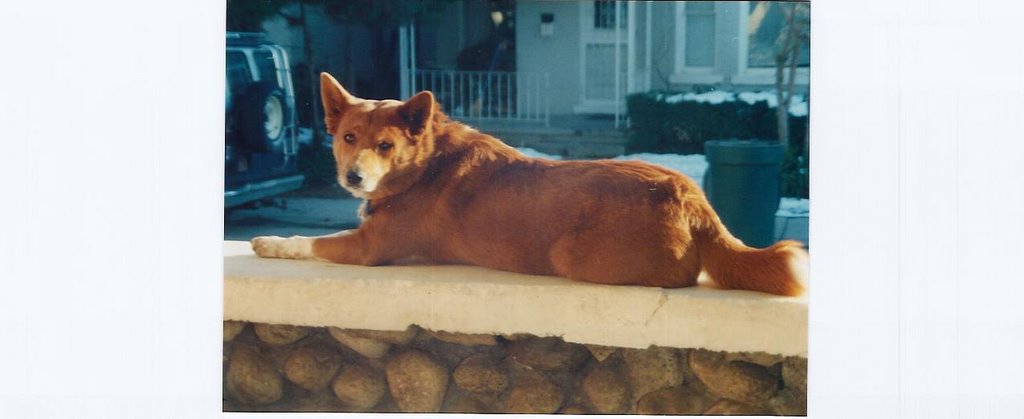

Cho Cho San is my first dog. She was skinny, stinky and crap-brown when I got her from the pound and...was slated to be euthanized the very next day. Luckily, I got to her first! She is my angel dog,and the most perfect dog ever, wonderful with other animals, all people, and especially with little kids. She is the kind of person I should be, and her generousity of spirit is truly inspiring.
Ever since I brought her home, Choobie's favorite place to hang out is on the wall of the front porch. From here, she can watch the world go by. She is an extremely social dog, and loves making new friends. In fact, she has more of a social life than I do(!) and regularly gets invited to dinner. She has a set of pearls for such occasions, and displays impeccable table manners.
[dogs]
[dog photos]
Subscribe to:
Posts (Atom)